- Create a PR to the upstream repo Mon, Aug 31st 2359
- Add Increments:
Level-4,A-CodeQuality - Get ready to review PRs before the tutorial
- Review some peer PRs during the tutorial
1 Create a PR to the upstream repo Mon, Aug 31st 2359
- Create a pull request (PR) from your fork to the upstream repo. Note the following:
- Create the PR from the
masterbranch of your fork to themasterbranch of the upstream repo (https://github.com/NUS-CS2113-AY2627-S1/ip) - Set the PR name as
[{Your full/partial name or your GitHub username}] iP
e.g.,[Richard Mathews Chee] iPor[Rich ... hee] iPor[TheRichMat] iP
Note that the PR name will be publicly visible.
You may leave the description empty.
You may leave theAllow edits by maintainersbox unchecked. If checked, maintainers of the upstream repo can push small fixes to your PR (for example, to resolve minor issues before merging). - If you created the PR correctly, it should appear in the list of PRs here.
- Steps for creating a PR are given in Git-Mastery → Lesson: T9L1. Creating Pull Requests (omit the 'preparation' step):
- Create the PR from the
There is no need to create new PRs every time you update the code in your fork. The PR will update automatically to reflect the latest code of the branch it was sent from (i.e., when you push changes to the master branch of your fork).
3 Get ready to review PRs before the tutorial
- Do the following to prepare for the PR review exercise you will be doing in the coming tutorial.
- Recall how to review PRs (related lesson: Git-Mastery → Lesson: T9L2. Reviewing Pull Requests).
- Read the Best practices for reviewing PRs @SE-EDU/guides. You are expected to follow all of them.
4 Review some peer PRs during the tutorial
This task is worth 2x2=4 participation points.
Learn how you should review PRs in this task (related lesson: Git-Mastery → Lesson: T9L2. Reviewing Pull Requests):
Step 1 Note these additional guidelines:
- Read the Best practices for reviewing PRs @SE-EDU/guides. You are expected to follow all of them.
- Make sure you add 'review comments' (not regular comments) as only those are counted for participation. See step 4 in the panel above to find out how to add 'review comments'.
- If the PR has received some review comments already, feel free to confirm/complement/question those comments in your review. Also, look for things the previous reviewers may have missed.
- At the end of the review, choose
Comment(i.e., notApproveorRequest changes).
Step 2 Do the first PR review as follows.
- Comment only on issues related to the coding standard.
Review comments don't always have to be about problems in the code. Other things you can do:- compliment the author on not making a common mistake
- ask questions
- suggest alternatives
- The review allocation is given in the panel below.
- Comment only on issues related to the coding standard.
If the student you have been allocated to review has not created a PR (or the PR has a trivial amount of code), you can review the Backup PR to review provided in the allocation table. Failing both, review another PR allocated to another student in your own tutorial but not in your team.
Tip for future reference: GitHub allows you to filter PRs/Issues using various criteria such as author:AuthorUsername (example -- see the filters text box in the target page).
Alternatively, you can use PR labels (if any) to filter PRs/Issues.
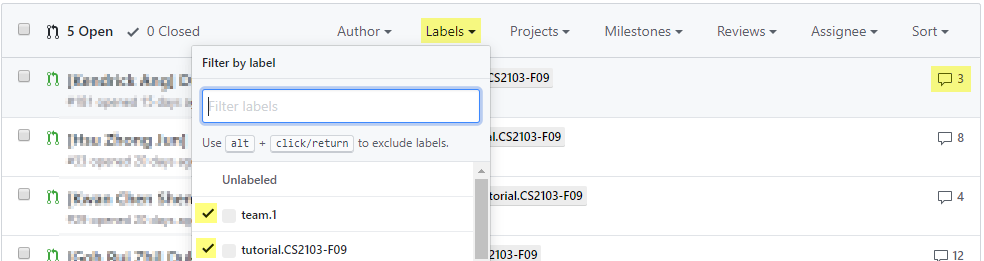
FAQ: How many comments should I add? Answer: Depends on the code being reviewed, but we expect most PRs would warrant at least 4-5 comments. If the PR is huge, you can stop when you think you've put in a fair amount of time on the job (~15 minutes) and added enough comments for the PR author to receive some value.
- Step 3 Do the second PR review as follows.
- Comment on other code quality guidelines (see the sections on Naming and Readability in this textbook chapter) you have learned so far. It's optional to comment on coding standard violations in this PR review.
- The review allocation is given in the panel below.
If the allocated PR is not suitable, use the same strategy as before to find an alternative PR to review.
- Step 4 [When you receive reviews for your own PR] Respond to comments received. You are recommended to (but not obliged to) respond to comments received from peers, especially if the PR reviewer asked you for more info. As mentioned in these guidelines, do not get into arguments with PR reviewers/authors.